
Not all children throw tantrums when they’re overwhelmed. Some go silent. I have one child that will screech the building down like he’s a tiny air raid siren, and another that will freeze and silently cry. This is something that is so easy to miss in a childcare setting. There is so much going on that a little one retreating to a corner and withdrawing doesn’t always raise an alarm.
If you’re parenting—or teaching—a quiet preschooler, it’s easy to assume they’re just shy, introverted, or still adjusting. But sometimes that quiet exterior hides a much bigger story. For some children, especially those who are autistic or neurodivergent, “quiet” isn’t calm—it’s shutdown.
Here are 10 subtle signs your quiet child might actually be struggling in their early years setting—and why it’s so important not to overlook them.
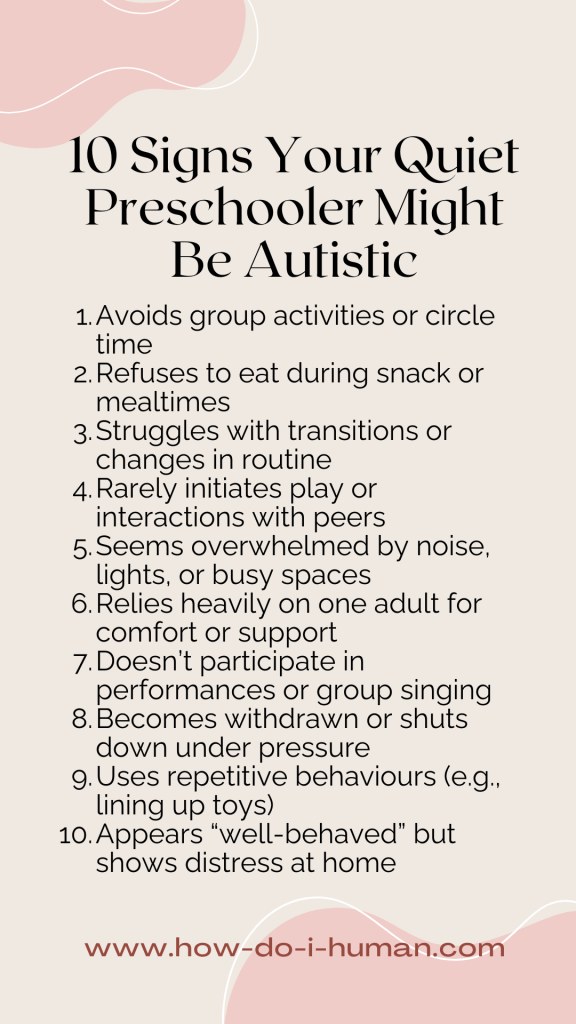
1. They Avoid Group Activities
Does your child consistently hang back during group time, crafts, or messy play? If they’d rather sit alone or wander the edges of the room, this might be a sensory or social overwhelm issue—not just a preference.
My personal experience: Both of my boys would actively become distressed if pushed to engage with group activities. They wanted to be left engage in a manner that was comfortable for them (usually playing nearby, but alone).
🧠 Why it matters: Many neurodivergent children find group dynamics confusing or overstimulating, especially if they’re highly sensitive to noise or unpredictability.
2. Snack Time is a Daily Battle
If your child refuses to eat during preschool snack time—but eats fine at home—that’s a red flag. It might be about the food, the environment, or the pressure of sitting with others.
My personal experience: It was thought by preschool that the boys just weren’t hungry and that was the reason they didn’t join in with snack time. I provided familiar snacks from home and that revealed the issue with sitting in company of the other children at snack time. Read about how I tackled this here: From Lunchbox Meltdowns to Lunchroom Success: Our Journey
3. They Stick to a Very Specific Routine
While all children benefit from routine, some become deeply distressed if anything changes. A different brand of crackers today or not having the bikes out on a Tuesday as expected? Cue tears or shutdown.
My personal experience: Even the smallest of changes to the classroom or routine was met with distress. They needed the familiarity of the environment and routine to feel safe and it was very easy to throw that off.
4. They Don’t Join In—Even with Encouragement
It’s normal for kids to be shy at first. But if they never join in, even after weeks or months, it might signal social communication differences rather than hesitation.
My personal experience: I saw there was an anxiety over getting things “incorrect” and this led to a reluctance to join in. They need to feel confident in what is expected of them before any attempt to join in will be made.
5. Meltdowns Happen After Preschool, Not During
This one’s big. If your child seems fine at nursery, but regularly explodes with emotion at home, they might be “masking”—holding it together all day only to unravel in a safe space.
My personal experience: This is such a tough one for everyone involved. Afternoon meltdowns were the norm for a long time and it resulted in inury and upset for myself and the children. It was the single biggest red flag that things were not OK.
🧠 Why it matters: Masking is incredibly exhausting for neurodivergent kids and can lead to burnout and anxiety.
Read here about how I handled this: Handling School When Your Child Is Facing Autistic Burnout
6. They’re Reliant on Comfort Objects or Staff Support
If your child always needs a familiar adult nearby, clutches the same toy tightly, or clings to a staff member during transitions, that might be emotional regulation at work, not just attachment.
My personal experience: There are specific staff members that are perceived as “safe” and are able to get more out of the boys. A special toy is always left in their bag for the staff to use to assist regulation in case of emergency.
7. Their Play is Highly Repetitive or Focused on Specific Themes
Many autistic children display focused interests—such as lining up trains or re-enacting the same scene. It’s easy to mistake this for typical play, but it can be a sign of neurodivergence.
My personal experience: If it doesn’t have wheels, it isn’t a toy. We saw solo play in the same spot with the same vehicles, acting out the same scenario every single day.
8. They Don’t Use Speech in the Setting (But Talk at Home)
This is often brushed off as shyness, but if a child speaks confidently at home yet doesn’t say a word in their early years setting, it’s worth exploring selective mutism or anxiety-related communication barriers.
My personal experience: I was approached about speech issues with both of my children, despite the fact they are both hyperverbal at home. I was having full blown discussions about how volcanos work, but preschool could barely get a yes or no response.
9. They Seem Sensitive to Sensory Input
Does your child react strongly to loud noises, bright lights, messy textures, or certain fabrics? Sensory processing difficulties are common in autistic children and can seriously impact their ability to engage.
My personal experience: Ear defenders were a life saver in allowing the children to feel more calm in a busy setting. Noise or getting wet are both a particular issue for them.
10. They’re “No Trouble”
This might sound like a good thing, but it’s not always. A child who blends into the background, doesn’t demand attention, and causes no disruption may be struggling in silence.
💬 Real talk: Quiet does not mean coping.
My personal experience: It turns out that an insistence on following the rules set in preschool to the letter, can be an indicator of autism. My children will tell others off for breaking the rules or become distressed if misbehaviour is witnessed. They need the framework that rules provide and breaches of this leave them feeling unsafe. It might look like they are just “good” children, but they are driven by an intense rigidity.
What You Can Do
If some of these signs are ringing alarm bells, here’s what you can do next:
- Trust your gut. You know your child best. If something feels off, it probably is.
- Start documenting behaviours. Patterns can help identify needs.
- Communicate with preschool staff. Share your concerns and ask what they’ve observed. Issues such a neurodivergence can take a while to emerge and so a “watch and wait” approach can often be helpful if everyone is on board.
- Get informed. Early intervention can make a huge difference if neurodivergence is part of the picture.
Want To Learn More?
Check out the National Autistic Society
Final Thought
Every child deserves to be seen, not just supervised. If you’ve got a quiet preschooler and something doesn’t sit right, don’t let politeness or fear stop you from speaking up. Sometimes the loudest struggles make the least noise.
Have you experienced this with your child? Were their struggles hidden behind a quiet exterior? Leave a comment and share your story—or send this to a fellow parent or educator who might need it.

Leave a comment