I like people. I enjoy being around them, having a laugh, and feeling connected. But in the same breath, socialising is exhausting and stressful. Other people are complex and unpredictable, and attempting to behave in a socially acceptable way with people who aren’t in my safe circle can leave me feeling like I’m physically fizzing from the effort.
I also seem to soak up the energy of others like a sponge, and it can affect my mood for days afterward. If someone’s in a bad mood, I’m suddenly in a bad mood. If someone’s energy is chaotic, my brain won’t stop buzzing. Because of this, I like to be alone—a lot!
When kids came along, though, I felt a lot of pressure to get out and get social. Babies are social creatures, apparently, so as a “good parent,” I needed to fulfil my duty by getting them involved in socialising early. Or so I thought.
Baby Groups and the Start of Socialisation
I found a couple of local baby groups that were pretty chill. I’d plonk myself down on the floor and try to join in the general camaraderie of parenthood. Large Child would sit next to me and play. He didn’t appear interested in the other children at all. He was only seven months old, so I thought, That’ll change as he gets older. Right?
Then Covid hit. Large Child turned one, and all socialising ground to a halt. Honestly, we were thrilled. We loved being together, doing our own thing, and not having to deal with the world outside our walls. We didn’t need constant interaction to enjoy each other’s company. It was peaceful, and it worked for us.
Small Child was born during this time. By the time baby groups restarted, Large Child had started preschool. It didn’t take long for his teachers to notice he was the type to play alone. He never spoke about the other children, never seemed interested in them, and seemed to treat them like part of the scenery.
He was two and a half, so again, I thought, That’ll change as he gets older. Right?
Preschool and Playdates
When Small Child started preschool, we immediately began to see the same behaviour. This surprised me because, at home, he had always seemed more outgoing than his brother.
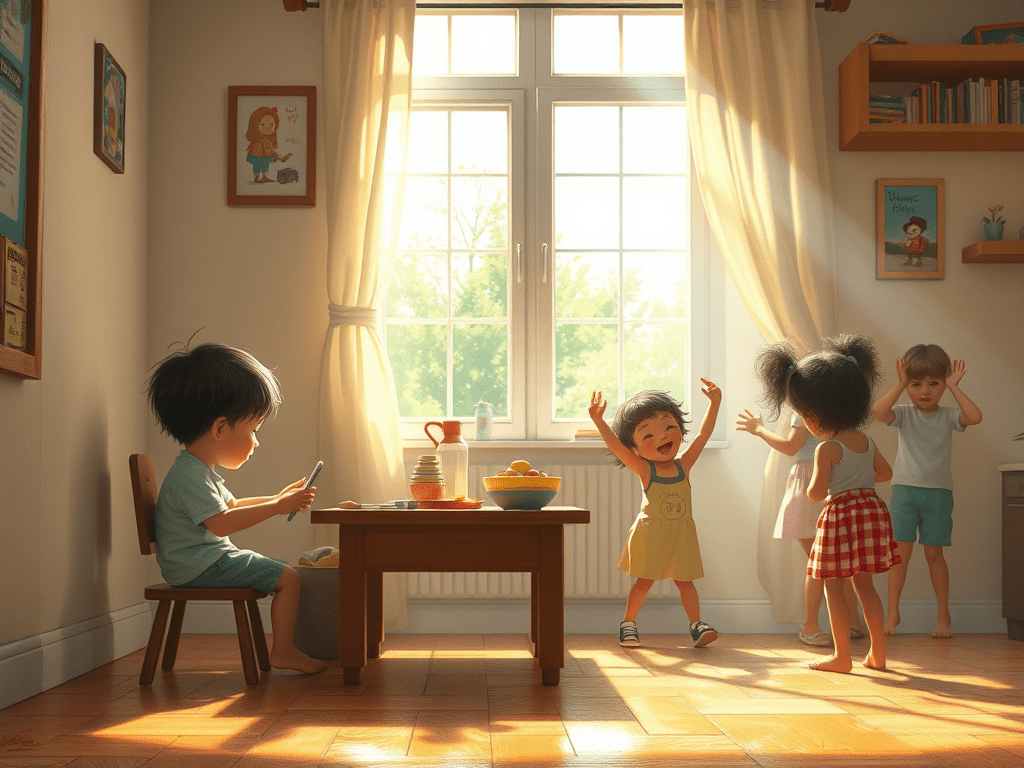
We tried soft play sessions, but they only enjoyed the equipment when the venue was nearly empty. If there were large or noisy groups, both boys seemed uncomfortable and spent most of the time clinging to me.
When they were four and two, I decided to try playdates outside of structured events. It didn’t go well. Both boys needed at least 30 minutes to warm up, and even then, there was no guarantee they’d join in.
Large Child would become overwhelmed and often have a meltdown. He’d tell me the other kids were too noisy, playing with toys “wrong,” or touching him when he didn’t want to be touched. Small Child was a little more adaptable but would soon start asking to go home, saying he’d had enough.
Birthday parties were an absolute nightmare. Two other kids at a gathering would be enough to cause stress. A room full of 17 sugar-fuelled, screaming children? Downright traumatic.
I found these events immensely stressful myself. My kids were a mess, and I felt embarrassed when we had to leave early or when it seemed like my boys just couldn’t tolerate being around other children. By this point, we knew about Large Child’s autism and had suspicions about Small Child, but I still believed they just needed time to adjust. I thought that if I persisted, they’d eventually get the hang of making and keeping friends.
Persistence and a Breaking Point
For the next year, I tried everything I could to help my boys socialise. I organised playdates, made accommodations, and adjusted my expectations. But despite all my efforts, a typical playdate would involve either endless meltdowns or both boys retreating to their tablets to watch Bluey, pretending no one else was there.
There was no in-between. No happy social place.
The breaking point came after a small Halloween party. Only a few other children were there, and I thought it might be manageable. But afterward, Large Child declared, “That was completely awful, and I never want to do it again.”
Small Child chimed in, “Can we just stay home, Mummy?”
A Shift in Perspective
I felt concerned. What was I doing wrong? I turned to my husband for advice. “How can we make them more comfortable?” I asked.
He looked at me, baffled. “When are you most comfortable socialising?”
I shrugged. “In a formal setting, like work or baby group. I like to leave people there and come home to be left alo… Oh.”
And that’s when it hit me.
I had been so focused on doing what I thought was “right” as a parent that I’d overlooked how I naturally like to socialise—and how similar my kids might be to me.
My husband was right. The boys weren’t struggling with socialisation because of anything I’d done wrong. They were simply wired differently.
Socialisation on Their Terms
Once I accepted this, everything started to make sense.
In their education settings, my boys are socially awkward but comfortable. They like to keep other kids at arm’s length, watching the fun rather than diving into the middle of it. They’re happy with the predictability and structure of school, where they know what to expect and where boundaries are clear.
Outside of school, they need time to decompress. The world is huge, unpredictable, and noisy—too much for anyone with a sensitive nervous system, let alone two little boys still figuring out how to navigate it.
So I gave up the playdates. The birthday parties. The constant pressure to do something.
Embracing Our Version of Normal
Weekends and holidays in our house are now for relaxing. We do quiet, outdoor activities like walking in the woods, visiting the beach on a rainy day, or having a picnic in the garden. And the best part? My kids are thriving.
I’ve come to terms with the fact that I’m not a bad parent. My kids’ reluctance to socialise isn’t because they’re “Covid babies” or because I didn’t try hard enough. It’s just who they are.
Society puts so much pressure on parents to encourage socialisation, as if a full calendar of playdates and parties is the gold standard for childhood development. But the reality is, kids don’t all fit into that mould. Some kids are hermits, and that’s okay.
Final Thoughts
If your kids are like mine—content to stay home, decompress, and avoid the chaos of traditional socialising—know that you’re not alone. You’re not failing them. You’re listening to their needs and respecting who they are.
Socialisation isn’t about following a prescribed set of rules. It’s about helping your kids find their own comfort zone and build meaningful connections on their terms.
In this house, we all like a lot of alone time. And that’s perfectly okay.


Leave a comment